11 May 2026 (Rome).
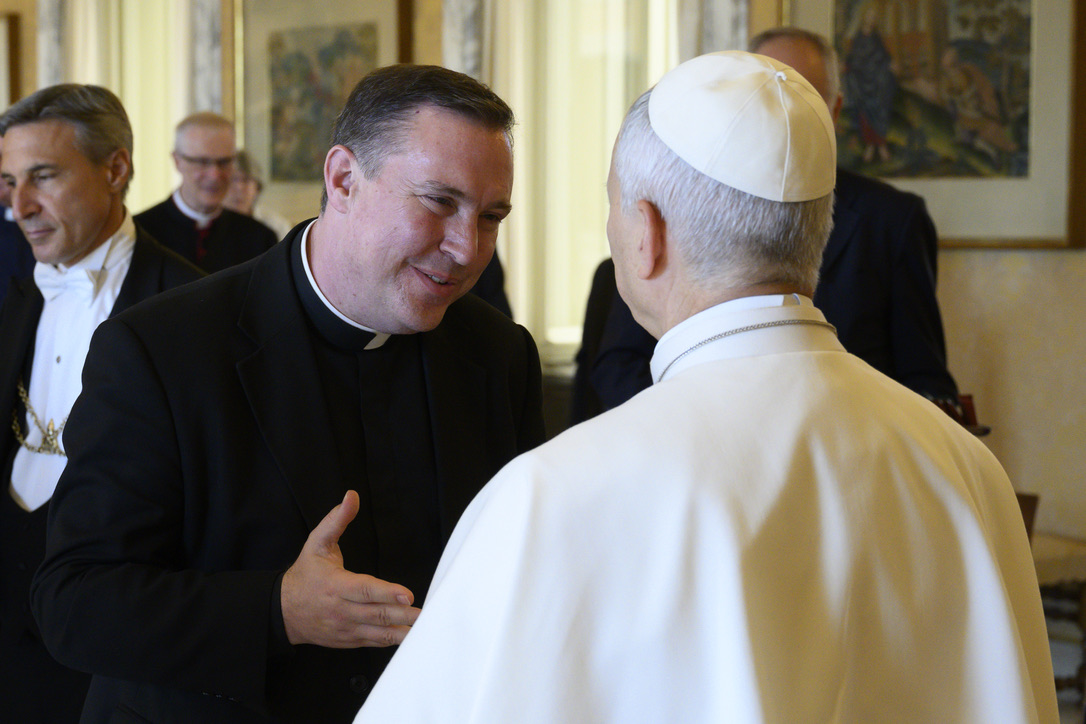
On the evening of Friday 8 May, we were honoured recently by a visit from Archbishop Paul Gallagher, the Holy See's Secretary for Relations with States and International Organisations — the Vatican's equivalent of a Foreign Minister. The occasion was a reception held in Archbishop Gallagher's honour to mark his appointment as Knight Commander of the Most Distinguished Order of St Michael and St George (KCMG), conferred by His Majesty King Charles III.
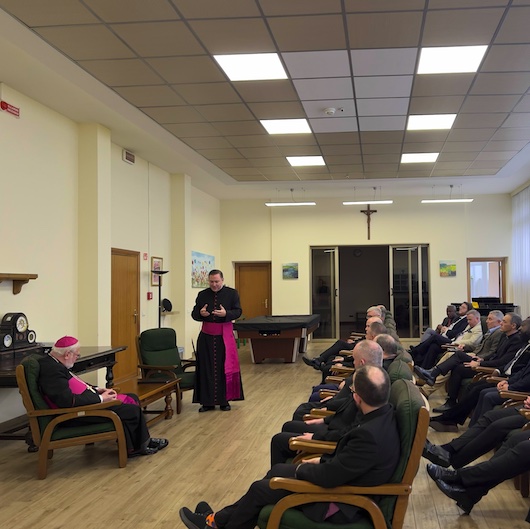
The evening began with Archbishop Gallagher joining the community for Vespers, after which staff and students of both the Beda and Scots colleges gathered together for a memorable hour-long conversation with Archbishop Gallagher. The meeting took place in the presence of the two rectors, Canon Marcus Holden of the Beda College and Canon Mark Cassidy of the Scots College.
Archbishop Gallagher spoke with characteristic warmth and candour about his remarkable life and priestly vocation. He traced his journey from family background and schooling through to his seminary formation at the Venerable English College in Rome, followed by further studies in Canon Law and his early years in parish ministry. He then described the path that led him to the Pontifical Ecclesiastical Academy — the Holy See's school for its diplomatic service — and then his career in the Church's diplomatic service, which took him to Tanzania, Uruguay, the Philippines — where he was part of the nunciature during the historic World Youth Day in Manila in January 1995 — the Council of Europe in Strasbourg, and as Apostolic Nuncio to Burundi, Guatemala, and finally Australia. It was there, he recounted, that he received the unexpected news of his appointment by Pope Francis as the Holy See's Foreign Minister.
Archbishop Gallagher went on to give the students a fascinating account of the work his office carries out at theSecretariat of State. The section for the Relations with States, which Archbishop Gallagher heads, is responsible for handling diplomatic relations with 184 countries and engages with some 80 resident ambassadors and 30 international organisations in Rome. The office is staffed by a dedicated team of around 60 people — including administrators and archivists — supporting the demanding workload. He described the breadth of what the role requires: staying closely informed about political and diplomatic developments across the globe; working with nunciatures and embassies; preparing detailed briefings and instructions for nuncios and meeting with ambassadors to advance the Church's mission of supporting local Catholic communities and engaging credibly with governments on issues of concern.
At the heart of the Holy See's diplomatic engagement, Archbishop Gallagher explained, lie two enduring principles: the promotion of religious freedom and the pursuit of peace, pursued always with the neutrality and impartiality that give the Holy See its unique voice on the world stage.
When Canon Marcus Holden asked Archbishop Gallagher about his hopes for the next generation, he offered a characteristically direct challenge. Having always been drawn to the world of politics himself, he said that in his encounters with young men and women, he would always encourage them not to stand on the sidelines and criticise politicians or dysfunctional systems, but to engage — to become politicians, to enter public life, and to work for change from within. Rather than lamenting the darkness, he would encourage the lighting of a candle.
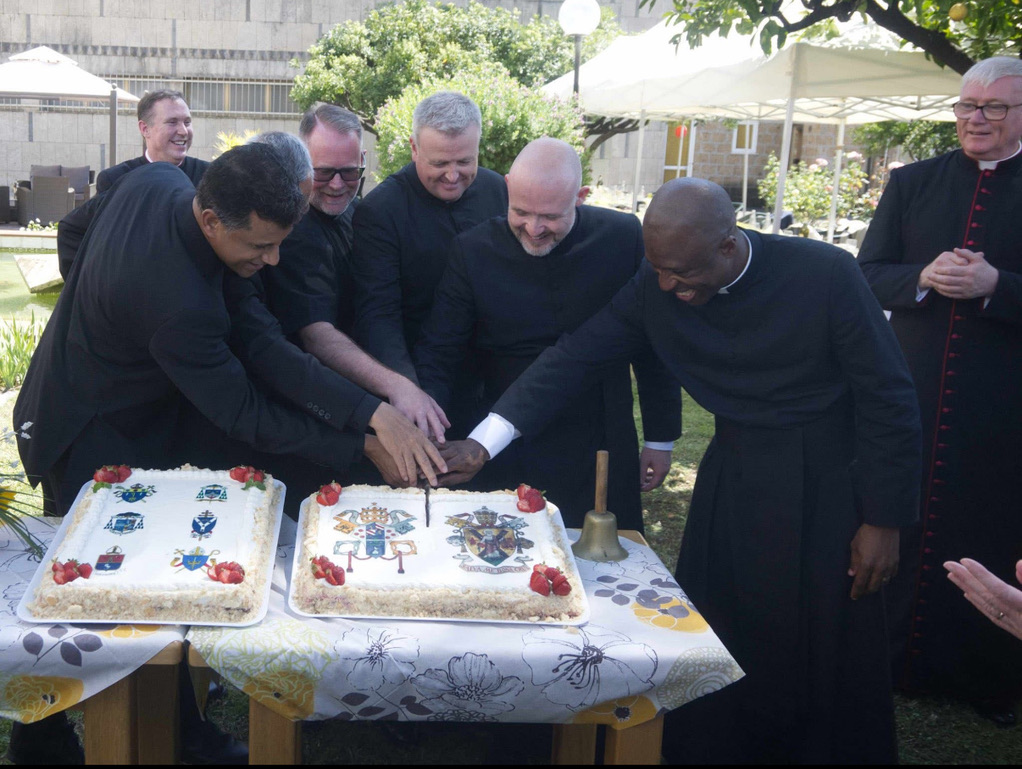
The evening concluded on a joyful note as Archbishop Gallagher blessed the newly built common room in the Beda Gardens, before the two college communities came together for a festal dinner in his honour. Archbishop Gallagher spoke with evident emotion about the honour, conscious that he was the first Englishman ever to serve as the Vatican's Foreign Minister. It was a fitting close to an evening that gave the whole community a deeper appreciation not only of Archbishop Gallagher's remarkable journey, but of the sensitive and critical work by which the the Section for Relations with States serves the mission of the Church in engaging with pressing current affairs on the world stage.